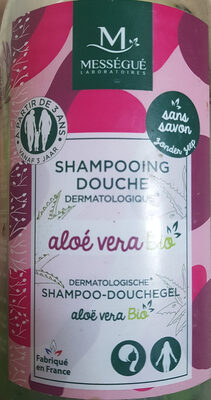
Shampooing douche aloé vera bio
Composition of Shampooing douche aloé vera bio by messegue-laboratoires: recorded on 14 August 2022, 18 ingredients.
Cosmetic recorded by Open Beauty Facts contributors
Points to note
Findings according to the 2022 list.
None of the names read is prohibited in all cases in European Union cosmetics; the transcribed list may be incomplete.
Who it concerns
For each group, the ingredients of the list that an official classification or rule mentions. Open an ingredient's page to read what the text says. A group with no name does not mean the ingredients were judged to have no effect for it.
Prohibition or serious classificationThe text prohibits the substance for this use, or ranks it among the most serious hazards (known or presumed carcinogenic, mutagenic or reprotoxic, identified endocrine disruptor).Worth watchingThe text sets a condition or flags a hazard worth knowing: allergen, suspected effect, condition for children, hazard to the aquatic environment.For informationOfficial information with no condition on a finished product: warning to read, irritation of the pure substance.
Skin, eyes and allergies
- Worth watching Parfum (Fragrance)“Parfum” stands for a mixture whose composition does not have to be detailed. Some allergenic substances must nevertheless be named separately in the ingredient list above 0.001% (leave-on product) or 0.01% (rinse-off product). The Regulation names them in 63 entries of its Annex III, for example Linalool, Limonene, Citronellol, Geraniol, Coumarin, Citral, Eugenol or Hexyl Cinnamal: if you are allergic to one of them, look for its name in the list.
- Worth watching Hexyl CinnamalAllergen to declare: Annex III, entry 87, requires it to be named in the ingredient list above 0.001% in a leave-on product and 0.01% in a rinse-off product, so that allergic people can avoid it.
- Worth watching LinaloolClassified under the CLP Regulation: skin sensitisation, category 1B (Skin Sens. 1B). Allergen to declare: Annex III, entry 84, requires it to be named in the ingredient list above 0.001% in a leave-on product and 0.01% in a rinse-off product, so that allergic people can avoid it.
- For information Potassium SorbateClassified under the CLP Regulation: eye irritation, category 2 (Eye Irrit. 2). This classification describes the pure substance; in a finished product it is far more diluted.
- For information Citric AcidClassified under the CLP Regulation: eye irritation, category 2 (Eye Irrit. 2). This classification describes the pure substance; in a finished product it is far more diluted.
No official text covers the recognised ingredients for: pregnancy and breastfeeding, babies and children, environment, read on the label.
For a question about your own situation (pregnancy, child, allergy), show this list to your doctor, midwife or pharmacist: we cannot say whether this product suits you.
Recorded composition
Ingredient list automatically transcribed by CompoAtlas from the photo by Open Beauty Facts contributors (two automatic readings, keeping only names given by both; it may therefore be incomplete): compare with the packaging. Added to CompoAtlas on 23 October 2026.
When the list changes, the old one remains available below with its date. The same barcode may cover several successive formulas.
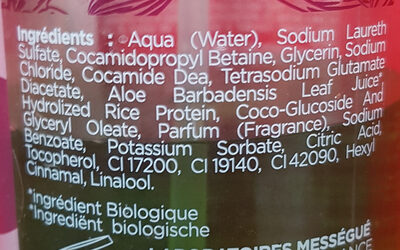
17 recognised ingredients out of 18.
Hover over or tap a badge for its meaning.
Classified hazard (cancer, DNA, reproduction): Carcinogenic, mutagenic or toxic for reproduction under the CLPEU regulation that classifies chemicals by their hazards (EC No 1272/2008). Regulation, or identified endocrine disruptor. Irritation, allergy and environment: see “Who it concerns”.
| Rank | On the label | Glossary name | Matching | European Union rule | Classified hazard (cancer, DNA, reproduction) |
|---|---|---|---|---|---|
| 1 | Aqua (Water) | AQUA | High name recognised, the brackets add a detail | No specific rule in the Cosmetics Regulation | none |
| 2 | Sodium Laureth Sulfate | SODIUM LAURETH SULFATE | Certain same name as in the EU glossary | No specific rule in the Cosmetics Regulation | none |
| 3 | Cocamidopropyl Betaine | COCAMIDOPROPYL BETAINE | Certain same name as in the EU glossary | No specific rule in the Cosmetics Regulation | none |
| 4 | Glycerin | GLYCERIN | Certain same name as in the EU glossary | No specific rule in the Cosmetics Regulation | none |
| 5 | Sodium Chloride | SODIUM CHLORIDE | Certain same name as in the EU glossary | No specific rule in the Cosmetics Regulation | none |
| 6 | Cocamide Dea | COCAMIDE DEA | Certain same name as in the EU glossary | Cited as an example in a rule, no rule of its own (Annex III) | none |
| 7 | Tetrasodium Glutamate Diacetate | TETRASODIUM GLUTAMATE DIACETATE | Certain same name as in the EU glossary | No specific rule in the Cosmetics Regulation | none |
| 8 | Aloe Barbadensis Leaf Juice* | ALOE BARBADENSIS LEAF JUICE | Certain same name as in the EU glossary | No specific rule in the Cosmetics Regulation | none |
| 9 | Hydrolized Rice Protein | HYDROLYZED RICE PROTEIN | Medium one letter away from a glossary name (likely typo) | No specific rule in the Cosmetics Regulation | none |
| 10 | Coco-Glucoside And | not recognised | Not recognised aucun nom du glossaire ne correspond | Name not recognised in the European glossary | none |
| 11 | Glyceryl Oleate | GLYCERYL OLEATE | Medium name found in a list printed without commas | No specific rule in the Cosmetics Regulation | none |
| 12 | Parfum (Fragrance) | PARFUM | High name recognised, the brackets add a detail | No specific rule in the Cosmetics Regulation | none |
| 13 | Sodium Benzoate | SODIUM BENZOATE | Certain same name as in the EU glossary | Preservative allowed under conditions (Annex V) Annex V, entry 1: products: a) Rinse-off products, except oral care products b) Oral care products c) Leave-on products; maximum concentration: a) 2.5% (acid) b) 1.7% (acid) c) 0.5% (acid) | none |
| 14 | Potassium Sorbate | POTASSIUM SORBATE | Certain same name as in the EU glossary | Preservative allowed under conditions (Annex V) Annex V, entry 4: maximum concentration: 0.6% (acid) | none |
| 15 | Citric Acid | CITRIC ACID | Certain same name as in the EU glossary | Entry for a mixture with the same CAS number (Annex V) | none |
| 16 | Tocopherol | TOCOPHEROL | Certain same name as in the EU glossary | No specific rule in the Cosmetics Regulation | none |
| 17 | Hexyl Cinnamal | HEXYL CINNAMAL | Certain same name as in the EU glossary | Allowed with restrictions (Annex III) | none |
| 18 | Linalool | LINALOOL | Certain same name as in the EU glossary | Allowed with restrictions (Annex III) | none |
Packaging photo dated (Automatic transcriptions of Open Beauty Facts ingredient-list photos (two AI readings, checked by text recognition)).

Product record
- Brand
- messegue-laboratoires
- EAN-13
- 3563210022523
- Quantity
- 1 l
- Packaging
- plastique
- Sales countries
- France
- Record created on
- 14 August 2022
- Open Beauty Facts record: photos, edit history
- Correct the Open Beauty Facts record
- All products from the brand: messegue-laboratoires
Fiche 3563210022523. Open Beauty Facts, export of cosmetic products, retrieved 15 November 2026.
Data “Open Beauty Facts and its contributors”, licensed under ODbL 1.0 (opendatacommons.org/licenses/odbl/1-0); derived table distributed under the same licence.
This list was copied by contributors on a given date. Compare it with the packaging of the product you have: brands change their formulas without always changing the barcode.
Is something on this product wrong or out of date, whether you are a reader or the brand? Write to contact@compoatlas.com: every correction is published in the corrections log.
Cite this page: CompoAtlas, “Shampooing douche aloé vera bio (messegue-laboratoires): composition and ingredients”, https://compoatlas.com/en/cosmetics/products/3563210022523-shampooing-douche-aloe-vera-bio, updated 14 August 2022.