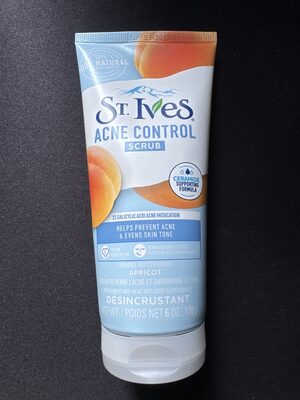
Apricot Acne Control Scrub
Composition of Apricot Acne Control Scrub by St-Ives: recorded on 9 August 2026, 33 ingredients. No prohibited ingredient or point to check under the EU rules we check.
Cosmetic recorded by Open Beauty Facts contributors
Points to note
No ingredient in the recorded list is prohibited in all cases in European Union cosmetics.
Who it concerns
For each group, the ingredients of the list that an official classification or rule mentions. Open an ingredient's page to read what the text says. A group with no name does not mean the ingredients were judged to have no effect for it.
Prohibition or serious classificationThe text prohibits the substance for this use, or ranks it among the most serious hazards (known or presumed carcinogenic, mutagenic or reprotoxic, identified endocrine disruptor).Worth watchingThe text sets a condition or flags a hazard worth knowing: allergen, suspected effect, condition for children, hazard to the aquatic environment.For informationOfficial information with no condition on a finished product: warning to read, irritation of the pure substance.
Pregnancy and breastfeeding
- Worth watching salicylic acidClassified under the CLP Regulation: reproductive toxicity, category 2 (Repr. 2), a hazard to the unborn child. The European Union nevertheless allows it under the conditions of its annex, after an opinion of its Scientific Committee on Consumer Safety (SCCS).
Babies and children
- Prohibition or serious classification salicylic acidAnnex III, entry 98, prohibits it in products intended for children under 3: “Not to be used in preparations for children under 3 years of age.” Annex V, entry 3, prohibits it in products intended for children under 3: “Not to be used in products for children under 3 years of age.”
- Prohibition or serious classification iodopropynyl butylcarbamateAnnex V, entry 56, prohibits it in products intended for children under 3: “a) Not to be used in products for children under 3 years of age, except in bath products / shower gels and shampoos”
Skin, eyes and allergies
- Worth watching fragrance (parfum)“Parfum” stands for a mixture whose composition does not have to be detailed. Some allergenic substances must nevertheless be named separately in the ingredient list above 0.001% (leave-on product) or 0.01% (rinse-off product). The Regulation names them in 63 entries of its Annex III, for example Linalool, Limonene, Citronellol, Geraniol, Coumarin, Citral, Eugenol or Hexyl Cinnamal: if you are allergic to one of them, look for its name in the list.
- Worth watching iodopropynyl butylcarbamateClassified under the CLP Regulation: serious eye damage, category 1 (Eye Dam. 1); skin sensitisation, category 1 (Skin Sens. 1).
- Worth watching limoneneClassified under the CLP Regulation: skin irritation, category 2 (Skin Irrit. 2); skin sensitisation, category 1 (Skin Sens. 1). Allergen to declare: Annex III, entry 88, requires it to be named in the ingredient list above 0.001% in a leave-on product and 0.01% in a rinse-off product, so that allergic people can avoid it.
- Worth watching linaloolClassified under the CLP Regulation: skin sensitisation, category 1B (Skin Sens. 1B). Allergen to declare: Annex III, entry 84, requires it to be named in the ingredient list above 0.001% in a leave-on product and 0.01% in a rinse-off product, so that allergic people can avoid it.
- For information salicylic acidClassified under the CLP Regulation: serious eye damage, category 1 (Eye Dam. 1). This classification describes the pure substance; in a finished product it is far more diluted.
- For information phenoxyethanolClassified under the CLP Regulation: serious eye damage, category 1 (Eye Dam. 1). This classification describes the pure substance; in a finished product it is far more diluted.
Environment
- Worth watching iodopropynyl butylcarbamateClassified under the CLP Regulation: hazardous to the aquatic environment, short term, category 1 (Aquatic Acute 1); hazardous to the aquatic environment, long term, category 1 (Aquatic Chronic 1).
- Worth watching limoneneClassified under the CLP Regulation: hazardous to the aquatic environment, short term, category 1 (Aquatic Acute 1); hazardous to the aquatic environment, long term, category 1 (Aquatic Chronic 1).
Read on the label
- For information salicylic acidAnnex III, entry 98, requires this to be printed on the pack: “(a) (b) (c) Not to be used for children under 3 years of age* * Solely for products which might be used for children under 3 years of age.”. Annex V, entry 3, requires this to be printed on the pack: “Salicylic acid: Not to be used for children under 3 years of age** **Solely for products which might be used for children under 3 years of age. Salicylic acid salts: Not to be used for children under 3 years of age*** ***Solely for products which might be used for children under 3 years of age and which remain in prolonged contact with the skin.”.
- For information iodopropynyl butylcarbamateAnnex V, entry 56, requires this to be printed on the pack: “a) Not to be used for children under three years of age (11) b) and c) Not to be used for children under three years of age (12)”.
For a question about your own situation (pregnancy, child, allergy), show this list to your doctor, midwife or pharmacist: we cannot say whether this product suits you.
Upcoming decisions and differences elsewhere
- LIMONENE : different rule in another country (South Korea).
Recorded composition
Ingredient list copied by Open Beauty Facts contributors. Added to CompoAtlas on 15 November 2026.
When the list changes, the old one remains available below with its date. The same barcode may cover several successive formulas.
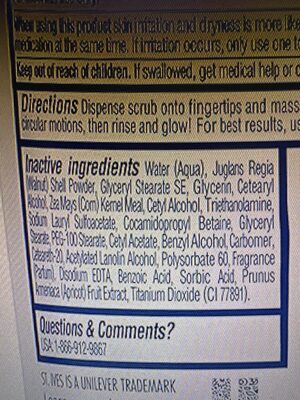
33 recognised ingredients out of 33.
Hover over or tap a badge for its meaning.
Classified hazard (cancer, DNA, reproduction): Carcinogenic, mutagenic or toxic for reproduction under the CLPEU regulation that classifies chemicals by their hazards (EC No 1272/2008). Regulation, or identified endocrine disruptor. Irritation, allergy and environment: see “Who it concerns”.
| Rank | On the label | Glossary name | Matching | European Union rule | Classified hazard (cancer, DNA, reproduction) |
|---|---|---|---|---|---|
| 1 | water (aqua) | WATER | High name recognised, the brackets add a detail | No specific rule in the Cosmetics Regulation | none |
| 2 | juglans regia (walnut) shell powder | JUGLANS REGIA SHELL POWDER | High name recognised, the brackets add a detail | No specific rule in the Cosmetics Regulation | none |
| 3 | glyceryl stearate se | GLYCERYL STEARATE SE | Certain same name as in the EU glossary | No specific rule in the Cosmetics Regulation | none |
| 4 | glycerin | GLYCERIN | Certain same name as in the EU glossary | No specific rule in the Cosmetics Regulation | none |
| 5 | cetyl alcohol | CETYL ALCOHOL | Certain same name as in the EU glossary | No specific rule in the Cosmetics Regulation | none |
| 6 | zea mays (corn) kernel meal | ZEA MAYS KERNEL MEAL | High name recognised, the brackets add a detail | No specific rule in the Cosmetics Regulation | none |
| 7 | cetearyl alcohol | CETEARYL ALCOHOL | Certain same name as in the EU glossary | No specific rule in the Cosmetics Regulation | none |
| 8 | salicylic acid | SALICYLIC ACID | Certain same name as in the EU glossary | Allowed with restrictions (Annex III) Preservative allowed under conditions (Annex V) Annex III, entry 98: products: (a) Rinse-off hair products (b) Other products except body lotion, eye shadow, mascara, eyeliner, lipstick, roll-on deodorant (c) Body lotion, eye shadow, mascara, eyeliner, lipstick, roll-on deodorant; maximum concentration: (a) 3.0% (b) 2.0% (c) 0.5% Annex V, entry 3: maximum concentration: Salicylic acid: 0.5% (acid) Salicylic acid salts: 0.5% (acid) | Toxic for reproduction: suspected effect (category 2, CLP classification) |
| 9 | triethanolamine | TRIETHANOLAMINE | Certain same name as in the EU glossary | Cited as an example in a rule, no rule of its own (Annex III) | none |
| 10 | cocamidopropyl betaine | COCAMIDOPROPYL BETAINE | Certain same name as in the EU glossary | No specific rule in the Cosmetics Regulation | none |
| 11 | peg-100 stearate | PEG-100 STEARATE | Certain same name as in the EU glossary | No specific rule in the Cosmetics Regulation | none |
| 12 | glyceryl stearate | GLYCERYL STEARATE | Certain same name as in the EU glossary | No specific rule in the Cosmetics Regulation | none |
| 13 | prunus armeniaca (apricot) fruit extract | PRUNUS ARMENIACA FRUIT EXTRACT | High name recognised, the brackets add a detail | No specific rule in the Cosmetics Regulation | none |
| 14 | prunus armeniaca (apricot) seed powder | PRUNUS ARMENIACA SEED POWDER | High name recognised, the brackets add a detail | No specific rule in the Cosmetics Regulation | none |
| 15 | phenoxyethanol | PHENOXYETHANOL | Certain same name as in the EU glossary | Preservative allowed under conditions (Annex V) Annex V, entry 29: maximum concentration: 1.0% | none |
| 16 | carbomer | CARBOMER | Certain same name as in the EU glossary | No specific rule in the Cosmetics Regulation | none |
| 17 | ceteareth-20 | CETEARETH-20 | Certain same name as in the EU glossary | No specific rule in the Cosmetics Regulation | none |
| 18 | sodium chloride | SODIUM CHLORIDE | Certain same name as in the EU glossary | No specific rule in the Cosmetics Regulation | none |
| 19 | sodium methyl lauroyl taurate | SODIUM METHYL LAUROYL TAURATE | Certain same name as in the EU glossary | No specific rule in the Cosmetics Regulation | none |
| 20 | fragrance (parfum) | PARFUM | High the exact glossary name is printed in brackets | No specific rule in the Cosmetics Regulation | none |
| 21 | polysorbate 60 | POLYSORBATE 60 | Certain same name as in the EU glossary | No specific rule in the Cosmetics Regulation | none |
| 22 | disodium edta | DISODIUM EDTA | Certain same name as in the EU glossary | No specific rule in the Cosmetics Regulation | none |
| 23 | peg-4 laurate | PEG-4 LAURATE | Certain same name as in the EU glossary | No specific rule in the Cosmetics Regulation | none |
| 24 | peg-4 dilaurate | PEG-4 DILAURATE | Certain same name as in the EU glossary | No specific rule in the Cosmetics Regulation | none |
| 25 | sodium benzoate | SODIUM BENZOATE | Certain same name as in the EU glossary | Preservative allowed under conditions (Annex V) Annex V, entry 1: products: a) Rinse-off products, except oral care products b) Oral care products c) Leave-on products; maximum concentration: a) 2.5% (acid) b) 1.7% (acid) c) 0.5% (acid) | none |
| 26 | lauric acid | LAURIC ACID | Certain same name as in the EU glossary | No specific rule in the Cosmetics Regulation | none |
| 27 | peg-4 | PEG-4 | Certain same name as in the EU glossary | No specific rule in the Cosmetics Regulation | none |
| 28 | iodopropynyl butylcarbamate | IODOPROPYNYL BUTYLCARBAMATE | Certain same name as in the EU glossary | Preservative allowed under conditions (Annex V) Annex V, entry 56: products: a) Rinse-off products b) Leave-on products c) Deodorants/antiperspirants; maximum concentration: a) 0.02% b) 0.01% c) 0.0075% | none |
| 29 | citrus aurantium peel oil | CITRUS AURANTIUM PEEL OIL | Certain same name as in the EU glossary | No specific rule in the Cosmetics Regulation | none |
| 30 | limonene | LIMONENE | Certain same name as in the EU glossary | Allowed with restrictions (Annex III) | none |
| 31 | linalool | LINALOOL | Certain same name as in the EU glossary | Allowed with restrictions (Annex III) | none |
| 32 | titanium dioxide (ci 77891) | CI 77891 | High Colour Index number printed in the list, CI prefix restored if needed | Allowed with restrictions (Annex III) UV filter allowed under conditions (Annex VI) Colorant allowed under conditions (Annex IV) Separate entry for the nano form (Annex VI) Annex III, entry 321: products: (a) face products in loose powder form (b) hair aerosol spray products (c) other products; maximum concentration: (a) 25%; (b) 1.4% for general consumers, and 1.1% for professional use. Annex VI, entry 27: maximum concentration: 25%* *: In case of combined use of Titanium Dioxide and Titanium Dioxide (nano), the sum shall not exceed the limit given in column g (Maximum concentration in ready for use preparation) | none |
| 33 | titanium dioxide (ci 77891) | TITANIUM DIOXIDE | High name recognised, the brackets add a detail | Allowed with restrictions (Annex III) UV filter allowed under conditions (Annex VI) Colorant allowed under conditions (Annex IV) Separate entry for the nano form (Annex VI) Annex III, entry 321: products: (a) face products in loose powder form (b) hair aerosol spray products (c) other products; maximum concentration: (a) 25%; (b) 1.4% for general consumers, and 1.1% for professional use. Annex VI, entry 27: maximum concentration: 25%* *: In case of combined use of Titanium Dioxide and Titanium Dioxide (nano), the sum shall not exceed the limit given in column g (Maximum concentration in ready for use preparation) | none |
The evidence date of this ingredient list is unknown.
Has the product changed? Photograph the packaging.
Product record
- Brand
- St-Ives
- EAN-13
- 0077043003497
- Quantity
- 170g (6oz)
- Categories
- Face, Face scrubs
- Sales countries
- Canada
- Record created on
- 27 July 2025
- Open Beauty Facts record: photos, edit history
- Correct the Open Beauty Facts record
- All products from the brand: St-Ives
Fiche 0077043003497. Open Beauty Facts, export of cosmetic products, retrieved 15 November 2026.
Data “Open Beauty Facts and its contributors”, licensed under ODbL 1.0 (opendatacommons.org/licenses/odbl/1-0); derived table distributed under the same licence.
This list was copied by contributors on a given date. Compare it with the packaging of the product you have: brands change their formulas without always changing the barcode.
Is something on this product wrong or out of date, whether you are a reader or the brand? Write to contact@compoatlas.com: every correction is published in the corrections log.
Cite this page: CompoAtlas, “Apricot Acne Control Scrub (St-Ives): composition and ingredients”, https://compoatlas.com/en/cosmetics/products/0077043003497-apricot-acne-control-scrub, updated 9 August 2026.